Postcards from: BDF 2025
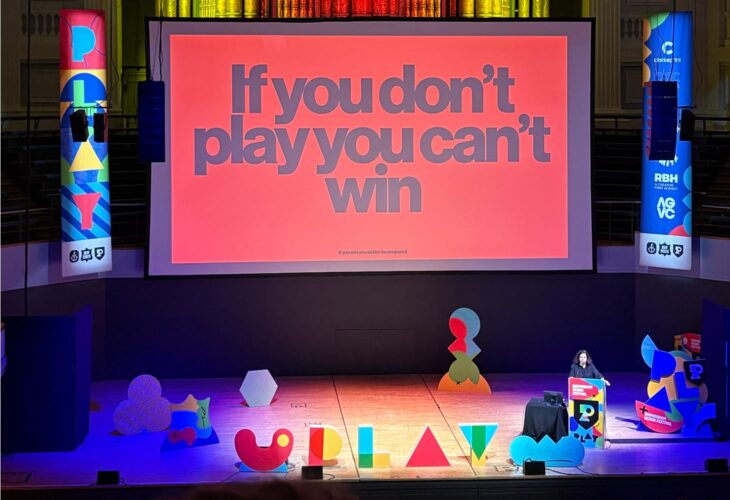
Last month, our designers took a trip up to Birmingham for the Birmingham Design Festival. This year’s theme was all about celebrating Play – a crucial tool in any designer’s toolkit.
The ideas from the day have had some time to settle, so we asked the team what’s stuck with them and what they’d write home about.
Izzy
‘Play’ is such an important part of the creative process that can be easily forgotten – so it was really refreshing to hear from designers embracing this idea in their work. I’m still thinking about the talk from Chris Clarke, who used simple collage to create punchy and impactful visuals for the Guardian’s election coverage in the UK and US, bringing a sense of playfulness and interactivity at a time of concern and uncertainty.
I’m also really interested in finding new ways to incorporate motion in my work, so I was inspired by Studio Dumbar’s visual identity for North Sea Jazz Festival. Using kinetic type to imitate sound waves, they created a modern and dynamic identity centred around motion. It was great to hear from a studio with such a priority for practice and experimentation within animation and 3D space.
Kate
As a digital-first designer, I really enjoyed the fresh take from Kelli Anderson. She gave fantastic insight on how, in a digital age that there is still a place for tactile projects, physical projects that invoke a sense fun and wonder. It’s something I keep thinking about as I start new projects.
Mike
Chris Clarke’s talk on the idea of ‘purpose-driven play’ – that exploration and having fun with things can still be a deeply serious and vital pursuit – has really stuck with me. Play can be a strategy, a ‘design system for thinking differently’, without which you can get caught in easy repetition of what’s worked before.
It reminds me of Rory Sutherland’s often-told story about bees and their ‘waggle dance’, illustrating the immense rewards that apparently ‘non-optimal’ behaviour can sometimes bring. It’s important that we as creatives safeguard space in our professional practise for play, resist the forces that always drive towards efficiency, and give ourselves room to find the new.
Dan
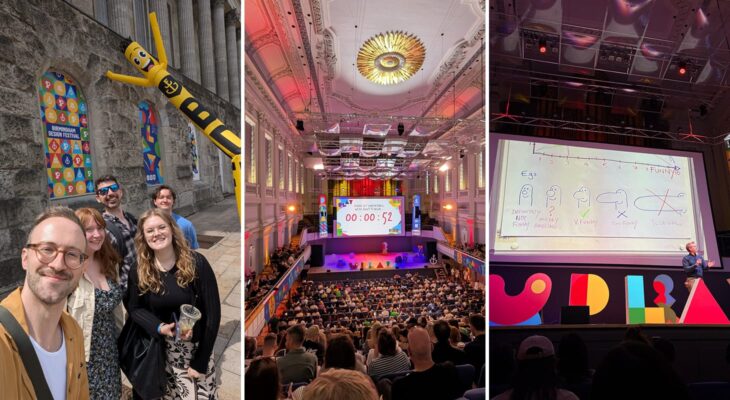
Kelli Anderson’s talk really resonated with me as she explored the role of different artifacts in design. These artifacts vary from the marks, wear and smudges in print, to even the artifacts of history through typography. It was a refreshing insight into the importance of the process, over the finished article/end point.
Sam
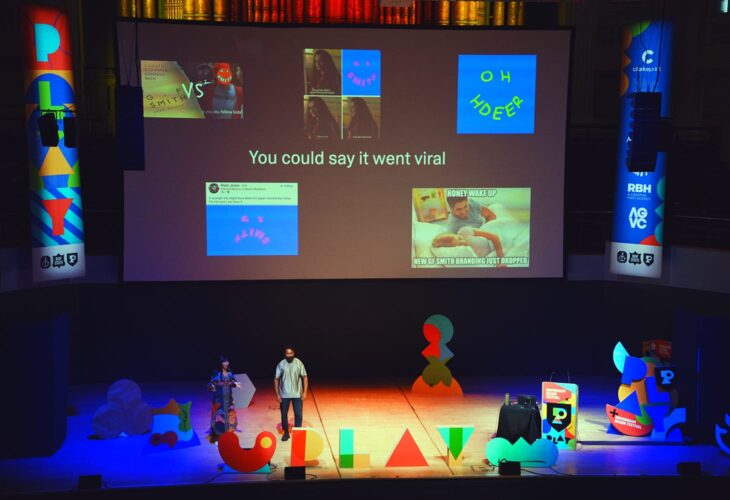
As designers it’s easy to become weighed down by the very guidelines and rules we create. We often forget the essence of what we do. At its core, design is a form of play, something that Templo fully embraced with their contemporary brand evolution for GF Smith.
I was struck by the candid approach of founders, Pali Palavathanan and Anoushka Rodda, who didn’t shy away from discussing the backlash their rebrand received. In fact, they leaned into it – explaining that GF Smith wanted to position their business within a more disruptive brand space centred around community. Once you understand the brief, the playful and friendlier direction makes complete sense. It’s a clear, strategic leap forward that better represents the company’s values today.
When designers dare to play and push boundaries with confidence, the results can be truly transformative. It’s an invitation to all of us in the creative field: don’t just design – play, experiment, and keep moving design forward.